










From Cells to Solutions: Emerging Tools for Studying Health and Disease — Session I
Sponsored by: The NIEHS Superfund Research Program (SRP)

The National Institute of Environmental Health Sciences (NIEHS) Superfund Research Program (SRP) is hosting a Risk e-Learning webinar series focused on the use of innovative, human-relevant technologies to better characterize the biological effects of chemicals.
New technologies, including advanced cell-based assays, organoids, and computational modeling approaches, are expanding the toolbox researchers use to answer previously difficult or unanswerable questions. Presenters will discuss how these emerging methodologies are being applied to uncover mechanistic insights, improve predictive accuracy for human health outcomes, and refine risk assessment frameworks.
The first session, titled Multi-Cellular Systems, Modeling, and Simulations to Advance Environmental Health Research, will feature four speakers discussing how cell-based systems, modeling, and simulations can improve researchers' understanding of complex biomedical topics, such as how chemicals interact inside the body or the cause of birth defects. Speakers include:
- Margaret Ochocinska, Ph.D., National Institutes of Health: Dr. Ochocinska will introduce the Complement-Animal Research In Experimentation (Complement-ARIE) Program, which aims to accelerate the development, standardization, validation and use of human-based New Approach Methodologies (NAMs) that more accurately model human biology to transform basic, translational, and clinical sciences. Complement-ARIE has already awarded $1M in a crowdsourcing prize competition, launched a $7M NAMs Reduction to Practice Challenge, and published funding opportunities to create Technology Development Centers, a NAMs Data Hub and Coordinating Center, and the Validation and Qualification Network. The Validation and Qualification Network (VQN) will be a Public Private Partnership (PPP) with the Foundation for NIH (FNIH) involving scientists at multiple levels of government (including funding agencies and regulators), industry, nongovernmental organizations, and academic institutions to accelerate adoption and implementation of NAMs in both research and regulatory contexts. The goal of the VQN is to build upon existing U.S. and international efforts to provide more cost-effective, rapid, human-relevant NAMs for drug discovery, chemical safety testing, and wider biomedical research approaches to bring NAMs products to market.
- Brian Johnson, Ph.D., Michigan State University: Dr. Johnson will combinatorial new approach methods to elucidate mechanisms of human thyroid hormone disruption by legacy and emerging chemical contaminants.
- Rebecca Fry, Ph.D., University of North Carolina: The talk will highlight how UNC Chapel Hill Superfund researchers are deploying new approach methodologies (NAMs) to improve chemical toxicity prediction and reduce reliance on traditional animal models. It will showcase UNC SRP innovations in computational toxicology, exposure science, and mechanistic assays, demonstrating how these tools accelerate risk prediction of hazardous chemicals.
- Jon Chorover, Ph.D., University of Arizona: Legacy mine tailings sites, which are prevalent throughout the western U.S., are potential sources for ingestion exposure to airborne arsenic-bearing particulate matter (mt-PM). Dr. Chorover's team postulated that the bioaccessibility of arsenic in mt-PM is related to its molecular speciation, which in turn, depends on weathering environment. In this webinar, Dr. Chorover discuss how we tested this hypothesis by sampling 12 sites in the western U.S. and subjecting the samples to a set of molecular spectroscopy analyses coupled to in vitro bioassays.
To learn more about and register for the other sessions in this webinar series, please see the SRP site.
 Michelle L. Heacock, Ph.D., NIEHS Superfund Research Program (heacockm@niehs.nih.gov)
Michelle Heacock, Ph.D., serves as the chief of the Hazardous Substances Research Branch, and is a health science administrator where she oversees Superfund Research Program (SRP) grants that span basic molecular mechanisms of biological responses from exposures to hazardous substances, movement of hazardous substances through environmental media, detection technologies, and remediation approaches. Dr. Heacock received her doctorate from Texas A&M University for her work on the interplay between DNA repair proteins and telomeres. Her postdoctoral work was conducted at NIEHS where she studied the DNA repair pathway, base excision repair. She has been with the NIEHS since 2007.
 Margaret Ochocinska, National Institutes of Health (ochocinm@mail.nih.gov)
Margaret Ochocinska, Ph.D, is a Program Director at the National Institutes of Health, where she oversees the Reengineering the Research Landscape program.
 Brian Johnson, Michigan State University (bjohnson@msu.edu)
Brian Johnson, Ph.D., is an Assistant Professor in the Departments of Pharmacology & Toxicology and Biomedical Engineering at Michigan State University. His interdisciplinary research laboratory specializes in the design, manufacturing, automation and testing of human derived models of development and disease to study intercellular signaling. He employs digital manufacturing (CNC machining and 3D printing) to construct biomimetic microenvironments that recapitulate intercellular signaling in development and disease. His translational research goals are to develop strategies and enabling technologies that increase precision in the treatment of disease and to identify chemical exposures that lead to birth defects in vulnerable populations.
 Rebecca Fry, Ph.D., University of North Carolina (rfry@email.unc.edu)
Rebecca Fry, Ph.D., serves as the Chair of the Department of Environmental Sciences and Engineering at UNC-Chapel Hill and The Carol Remmer Angle Distinguished Professor in Children’s Environmental Health also in the Department of Environmental Sciences and Engineering at UNC-Chapel Hill. Fry also serves as the Director for the Institute for Environmental Health Solutions. Her lab focuses on understanding how environmental exposures to toxic substances are associated with human disease. With a particular focus on genomic and epigenomic perturbations, her labs use toxicogenomic and systems biology approaches to identify key molecular pathways that associate environmental exposure with diseases. A current focus in the lab is to study prenatal exposure to various environmental contaminants including arsenic, cadmium, and perflourinated chemicals. Dr. Fry aims to understand molecular mechanisms by which such early exposures are associated with long-term health effects in humans. Ultimately, Dr. Fry’s lab aims to identify mechanisms of contaminant-induced disease and the basis for inter-individual disease susceptibility
 John Chorover, University of Arizona (chorover@arizona.edu)
John Chorover, Ph.D, is a Professor and Head of the Department of Soil, Water and Environmental Science at the University of Arizona. He received his B.S. in environmental science from the University of Michigan, M.S. in forest science and Ph.D. in soil and water chemistry from UC Berkeley. He worked as an NSF postdoctoral fellow in Analytical Chemistry at the University of Geneva and was on the faculty of Penn State University before joining the faculty of University of Arizona. His research group explores the biogeochemistry of soil, sediment and water through laboratory and field-based experiments probed with advanced analytical chemistry techniques. Of particular interest is resolving how mineral-organic interactions influence the weathering of soils, the stabilization of organic carbon, and the speciation, mobility and bioaccessibility of pollutants. He directs a core analytical chemistry facility, the Arizona Laboratory for Emerging Contaminants and serves as PI of the UA-led, NSF-funded Santa Catalina Mountains – Jemez River Basin Critical Zone Observatory.
Moderators:
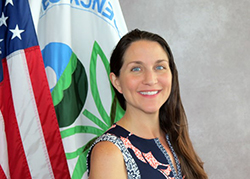 Jean Balent, U.S. EPA Office of Superfund and Emergency Management (OSEM) (balent.jean@epa.gov or 202-566-0832)
Ms Balent is on the staff of the EPA's Technology Innovation and Field Services Division where she has worked to collect and disseminate hazardous waste remediation and characterization information since 2003. Ms Balent manages the Clean Up Information Network website and actively supports online communication and collaboration resources available to EPA. She formerly worked with the US Army Corps of Engineers Environmental Engineering Division in the Buffalo District. Ms Balent was also a member of the SUNY-Buffalo Groundwater Research Group where she constructed and tested large scale models of groundwater flow. Ms Balent has also conducted research relating to the Great Lakes, environmental remediation, and brownfields re-development. She holds a Bachelor's degree in environmental engineering from SUNY-Buffalo and a Master's degree in Information Technology from AIU.
 Christopher G. Duncan, Ph.D., NIEHS (christopher.duncan@nih.gov)
Christopher (Chris) Duncan, Ph.D., is a Program Administrator in the Genes, Environment, and Health Branch of the NIEHS Division of Extramural Research and Training. Duncan leads the development and coordination of extramural programs that leverage data science approaches to address environmental health challenges. In this role, he manages a portfolio of research and resource grants in areas of data science relevant to the field of Environmental Health Sciences (EHS). Additionally, Duncan leads NIEHS implementation efforts for the NIH Policy for Data Management and Sharing, and he coordinates efforts to make EHS data more findable, accessible, interoperable, and reusable (FAIR). Prior to his current role, Duncan completed a cross-divisional postdoctoral fellowship in epigenetics with the NIEHS Divisions of Intramural Research, Extramural Research and Training, and the National Toxicology Program.
-
 Slide Presentation for Margaret Ochocinska, National Institutes of Health (2.28MB/PDF)
-
Slide Presentation for Brian Johnson, Michigan State University (7.38MB/PDF)
-
Slide Presentation for Rebbeca Fry, University of North Carolina at Chapel Hill (1.91MB/PDF)
-
Slide Presentation for Jon Chorover, University of Arizona (3.68MB/PDF)
-
Slide Presentation for Michelle Heacock, Superfund Research Program (806KB/PDF)
Webinar Slides and References:
-
Slide Presentation for Margaret Ochocinska, National Institutes of Health (2.28MB/PDF)
-
Slide Presentation for Brian Johnson, Michigan State University (7.38MB/PDF)
-
Slide Presentation for Rebbeca Fry, University of North Carolina at Chapel Hill (1.91MB/PDF)
-
Slide Presentation for Jon Chorover, University of Arizona (3.68MB/PDF)
-
Slide Presentation for Michelle Heacock, Superfund Research Program (806KB/PDF)
Additional Resources:
- NIEHS Superfund Research Program (SRP):
- SRP Homepage
- SRP Overview Video
- Other SRP Webinars
- Subscribe to the SRP News & Highlights newsletter
- NIH Complement-ARIE Program:
Thank you for participating in our webinar. We would like to receive any feedback you might have that would make this service more valuable.
Help & FAQs
- Frequently Asked Questions
- Content Questions?
Call Mali Velasco at 919-794-4708 or mali.velascodelgado@nih.gov - Technical Problems?
Leave us a comment - Cancel Your Registration
- My Participation Records
- CEU Credits and PDHs
Zoom Resources
Before Webinar Day
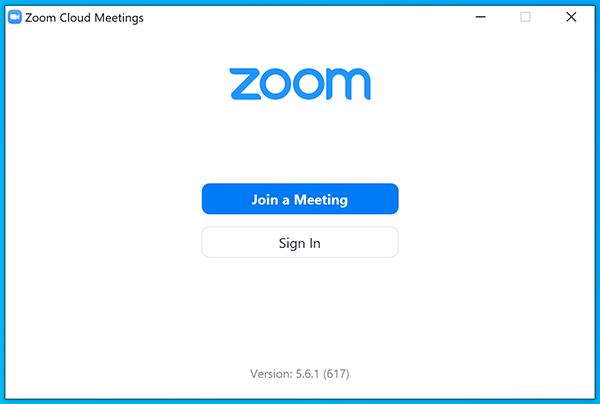
This seminar will be delivered through Zoom. Participants are encouraged to update to the latest version of the Zoom application for the best experience.
If you are unable to install the Zoom application, most functions will be available if you join just using a modern web browser such as Chrome, Edge or Firefox. We strongly encourage you to run the Zoom Meeting Test prior to attending this webinar. Technical support on the day of the webinar will be very limited and subject to significant delays.
Backup Conference Call
If you cannot participate using online audio, you may join the optional call in line. After checking in for the live event using the instructions listed below, you will see several options to participate. Please click the links in option 4 to follow along by phone and obtain the call in number. If you cannot access the phone number, you may request the call in line from the event moderator in the Q&A or send an email to Jean Balent at balent.jean@epa.gov
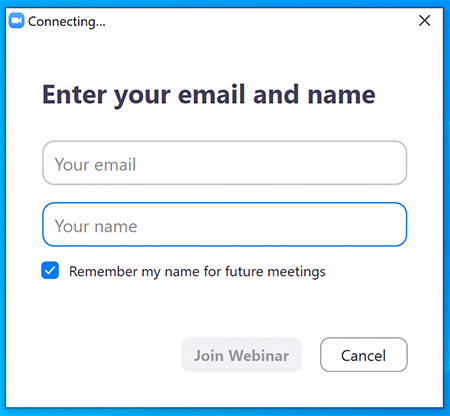
Click on "Join Webinar" at the top of this screen, enter your exact first and last name as you registered and enter the number of people attending at your location (including yourself). You should then be taken to the Zoom meeting room. Join with Zoom Application: For those joining with the Zoom application, you may be prompted to sign with a zoom account or join as a guest without signing in.
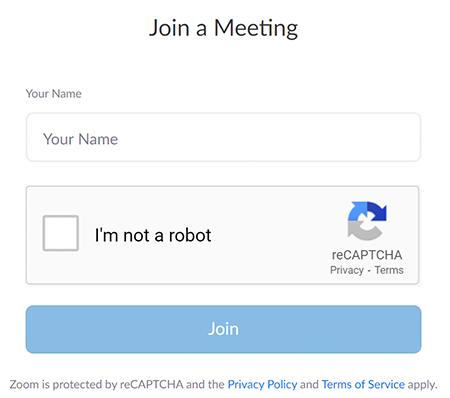
If joining as a guest, you will be prompted to enter your name and email address. Remember your name, image, video or voice may be visible to others in the live event. When done, click "Join" When it is time for the live event to start, the meeting host will admit you to the live Zoom meeting. Join via web browser (without the Zoom Application): For those joining with a web browser, you may close any pop ups prompting you to download the Zoom app. The next window will allow you to enter your name (first name and last name) and check the box that you are not a robot. Click the blue join button. You may also be asked to provide your email address before joining the room. Remember your name, image, video or voice may be visible to others in the live event. When done, click "Join" When it is time for the live event to start, the meeting host will admit you to the live Zoom meeting. You may need to periodically refresh the browser window to confirm if the host has admitted you. The presenters will control what slide you are viewing. You may submit questions online for the instructors to answer during the webinar by typing in the "Q&A" area. It is not necessary to wait until the question and answer periods to submit questions. At the end of the webinar you will be guided to our feedback form and links to additional resources, including the complete presentation. These links will remain active after the webinar. Provided for your convenience. Importing or accepting the invitation within this iCalendar file is not required, and declining the invitation does not cancel your registration. For additional information on iCalendar, please see our
iCalendar Help It is EPA's policy to make reasonable accommodation to persons with disabilities wishing to participate in the agency's programs and activities, pursuant to the Rehabilitation Act of 1973, 29 U.S.C. 791. Any request for accommodation should be made to at or , preferably one week or more in advance of the webinar, so that EPA will have sufficient time to process the request. EPA would welcome specific recommendations from requestors specifying the nature or type of accommodation needed. EPA welcomes specific recommendations from requestors specifying the nature or type of accommodation needed. Please note that CLU-IN provides both alternate phone call-in options and closed captioning for all webinars, and requests for these specific accommodations are not necessary.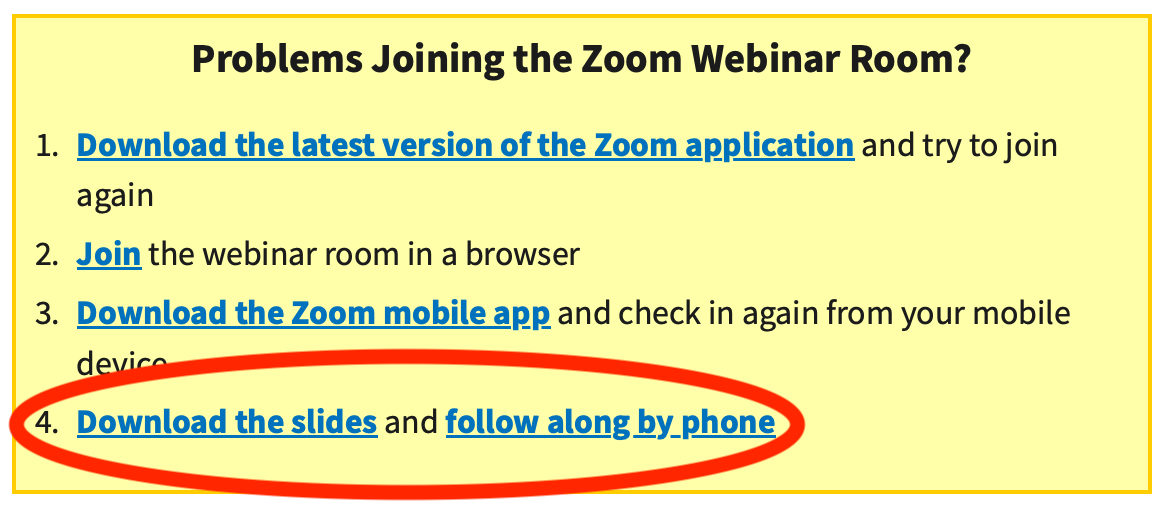
Webinar Day, Checking In
Moving Through Slides
Feedback & Links to Additional Resources
iCalendar File
Rehabilitation Act Notice for Reasonable Accommodation
Rehabilitation Act Notice for Reasonable Accommodation
It is EPA's policy to make reasonable accommodation to persons with disabilities wishing to participate in the agency's programs and activities, pursuant to the Rehabilitation Act of 1973, 29 U.S.C. 791. Any request for accommodation should be made to at or , preferably one week or more in advance of the webinar, so that EPA will have sufficient time to process the request. EPA would welcome specific recommendations from requestors specifying the nature or type of accommodation needed. EPA welcomes specific recommendations from requestors specifying the nature or type of accommodation needed. Please note that CLU-IN provides both alternate phone call-in options and closed captioning for all webinars, and requests for these specific accommodations are not necessary.
Webinar Recording
By participating in this CLU-IN webinar, you automatically agree to authorize recording of audio and visual content presented during this live event and consent to subsequent use of this recording in the public domain by the U.S. Environmental Protection Agency. This recording may include questions, comments and poll responses provided by you during the live event in addition to your name, voice, image or likeness. This recording will be made available after the conclusion of the live event as part of the CLU-IN webinar archives, and will remain available indefinitely. If you do not wish to consent to the recording, please do not join the live event, and contact Jean Balent at 202-566-0832 or balent.jean@epa.gov to discuss your concerns.
Content Disclaimer
This webinar is intended solely to provide information to the public. The views and opinions expressed as part of this webinar do not necessarily state or reflect those of the U.S. Environmental Protection Agency. It is not intended, nor can it be relied upon, to create any rights enforceable by any party in litigation with the United States, or to endorse the use of products or services provided by specific vendors. With respect to this webinar, neither the United States Government nor any of their employees, makes any warranty, express or implied, including the warranties of merchantability and fitness for a particular purpose, or assumes any legal liability or responsibility for the accuracy, completeness, or usefulness of any information, apparatus, product, or process disclosed, or represents that its use would not infringe privately owned rights.